Sitting is the only cost on a car that never sends an invoice.
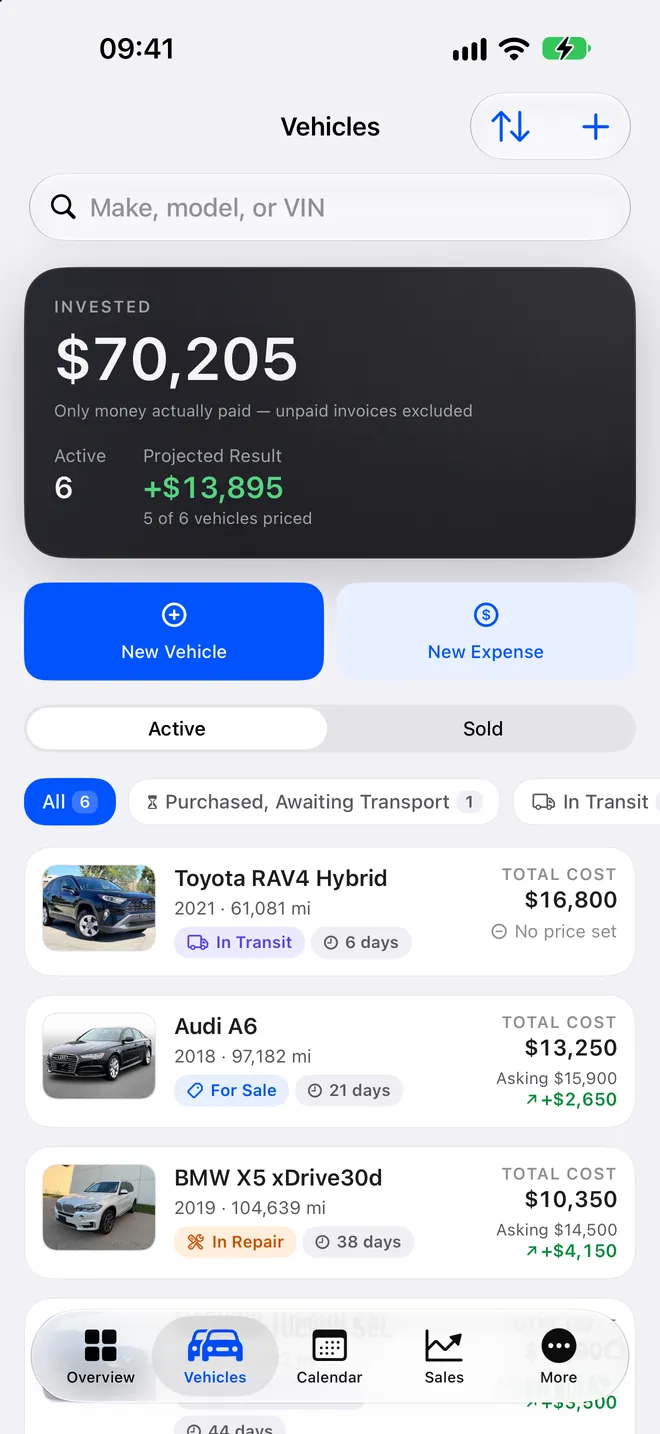
Deelary shows days held on every car, sorts the lot by age, nudges you at 45 days and again at 75, and reports profit per day of capital so a slow lane stops looking cheap.
The number that decides the year
Two cars. Car A: bought for $7,000, sold 24 days later for $8,900, real profit $1,400. Car B: bought for $9,000, sold 96 days later for $12,100, real profit $2,200. Car B made $800 more. Car A made $58 a day of capital; Car B made $23. Over a year, the dealer who runs Car A's pattern turns the same money nearly four times as often and ends up well ahead, even though every single deal looks smaller.
You do not get paid per car. You get paid per dollar, per day, that your money is out working. That is the whole feature.
What the app does with it
- Days held on every car. From the purchase date to today, or to the sold date. On the car and in the list.
- Sort the lot by age. The inventory view sorts by days held with one tap. The oldest cars are the ones to reprice.
- A nudge at 45, a harder one at 75. Those are the points where most small lots start losing the argument with themselves.
- Profit per day in the reports. By source and by make, so the lane that feels cheap but sells slowly shows up as what it is.
Why the nudge is on the phone
Aging reports exist in every dealer management system, printed on Monday and read on Tuesday if at all. The car you keep walking past does not need a report. It needs a number next to it, on the screen you already have in your hand, at the moment a buyer asks what you can do on it. Forty-one days is a different answer from nine.
Holding cost, if you want it
Days held and profit per day do not need a dollar figure for holding. If you have one, lot rent and insurance per car per day or floor plan interest, add it as an expense on the car and the margin reflects it. The app does not invent a daily rate, because the honest number for a driveway is close to zero and the honest number for a leased lot on a floor plan is not.
The longer version
Days on the lot: the number that quietly eats your profit works through the arithmetic in full. The flip profit calculator lets you try it on one car, and profit tracking is where the days meet the margin.
Free for two cars on iPhone and iPad. Deelary Pro is $8.99 a month or $49.99 a year. Details on the pricing page.
Questions
When does the day count start and stop?
It starts on the purchase date you enter and stops on the sold date. While you own the car it counts to today. The count is on every car in the inventory view and on the car itself.
What happens at 45 and 75 days?
The car is flagged in the inventory view at 45 days and flagged harder at 75. The point is not the number, it is that the car you walk past every morning gets a count instead of a feeling.
Why profit per day and not just profit?
Because the same money can only be in one car at a time. A $1,400 profit in 24 days is $58 a day of working capital. A $2,200 profit in 96 days is $23. The smaller deal funds nearly four times as much buying over a year. Profit per day is in the sales report, by source and by make.
Does it add a holding cost automatically?
No. The right daily cost is different for a driveway and a leased lot with floor plan interest, so the app does not guess. If you know yours, add it as an expense on the car. Days held and profit per day work either way.
Can I see the whole lot by age?
Yes. Sort the inventory view by days held and the oldest cars are at the top. That list is the one to look at before Monday pricing.