Profit is not sale minus purchase. The app knows that on every car.
Deelary rolls the purchase, every fee, every receipt and the days held into one total per vehicle, and shows the margin at your asking price before you have decided whether to do the brakes.
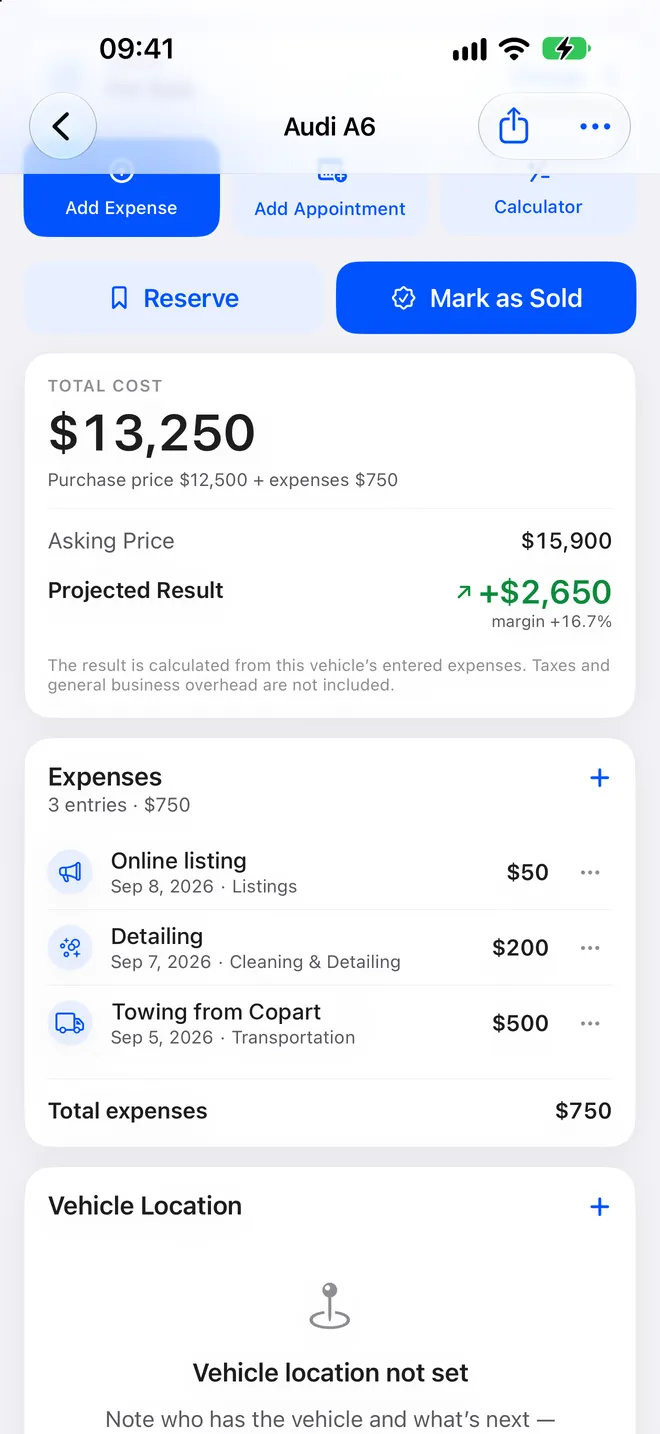
What the number on the car means
Open any vehicle and the top of the screen is its total cost: the purchase price plus every expense logged against it. Under that is the asking price and the projected result, which is the margin you would make at that price today. Add a $240 tire receipt and the total cost rises by $240 and the projected result falls by $240, in the same second. There is no end-of-month reconciliation because there is nothing to reconcile.
When the car sells, you enter the actual sale price and the projected result becomes the real one. It stays on the car forever, so the sales report is built from what happened and not from what you remember happening.
Why live matters
The decisions that make or lose the margin happen while you are standing at the car. Whether to replace the second tire or let it go. Whether to take the $7,900 or hold for $8,400. Whether this car at this price is worth another week on the lot. Each of those is a question about the number that is on the screen, and in most dealer software that number lives in a spreadsheet you will update on Sunday.
The same number, across the lot
The inventory view shows every car with its total cost, asking price, projected margin and days held. Sort by margin and the cars paying for the month rise to the top. Sort by days and the ones that need a price cut rise instead. The days on the lot feature has its own page, because sitting is the cost nobody invoices you for.
Profit by source and by make
The sales report groups sold cars by where they came from and by what they were. Real profit and average days held for each. This is where the habit gets tested: the auction lane you prefer is often the one that costs $300 more per car in reconditioning, and nothing short of grouping the cars will show it.
Where the costs come from
Profit tracking is only as honest as the costs under it. Deelary's expense tracking reads the receipt from a photo at the counter and attaches it to the car, which is the only way the small ones survive.
See it on one car first
The flip profit calculator runs this exact arithmetic in the browser on a single car, free, with no account. Free for two cars in the app on iPhone and iPad; Deelary Pro is $8.99 a month or $49.99 a year. Details on the pricing page.
Questions
What is the difference between projected and real profit?
Projected profit is what the car would make at your current asking price, given everything spent on it so far. It moves every time you add a cost or change the price. Real profit is locked when you mark the car sold at the actual sale price. The app shows projected on cars you own and real on cars you have sold.
Does it include the days the car sat?
It shows days held next to profit on every car, and profit per day in the reports. If you want a dollar figure for holding cost, add it as a cost line like any other. The app does not invent a daily rate for you, because the right number is different for a driveway and a leased lot.
Can I see profit across all the cars at once?
Yes. The inventory view lists every car with total cost, asking price, projected margin and days held, sortable by any column. The sales report totals real profit for the month, the quarter or any range you pick.
What about profit by where I bought the car?
The sales report groups sold cars by source and by make, with real profit and average days for each. After a dozen cars it shows which lane produces the margin and which one only looks cheap.
Is my asking price used anywhere else?
In the calculator. Enter what a buyer offers and the app shows what that offer leaves you after everything already on the car, so you answer with a number.